Category: Blog

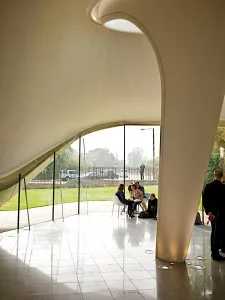
©Hélène Binet, Aquatics Centre

FROM THE ARCHIVE: The first London building by Zaha Hadid

The Aquatics Centre was the only new venue included within London’s bid for hosting the 2012 Olympic Games. Zaha Hadid had won the design competition in 2004, a year before London was chosen to be the host. In this interview she speaks about the East London site, the design process, materials and ideas behind the space.

What was more important as a starting point for the Aquatics Centre, designing a public building in East London or an architectural space for the Olympics?
It was important to develop a strong design that celebrated all the aquatic sports at the Olympics, but the building must also leave an outstanding legacy as a public facility for everyone in London for many generations after the games.  The wave-formed roof design is very appropriate for aquatic sports – combined with the large size and high quality of its construction – create an elegant and simple expression of celebration of water – which everyone seems to understand without much explanation.

Once London was awarded the Games, the organizers instructed that they would be the most sustainable Olympics in history. Therefore, the central idea across all the new London 2012 Olympic venues was to design and construct venues for the long-term legacy after the Games. These new venues are then temporarily adapted for use during the Olympics. This is key to the sustainability of all Olympic development – and very important for London, as the city cannot afford to be left with many expensive, oversized and under-used venues.
Read more

[mashshare]

Zaha Hadid 1950-2016 – A visionary and creative force

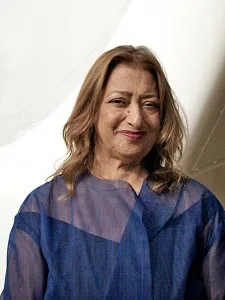
The sudden death of architect Dame Zaha Hadid last Thursday in Miami has been a shock. At the hight of her career, honoured with several awards, including the RIBA Gold Medal in the beginning of this year, she was a pioneering force in a male-dominated profession, occupying a global position as one of the most influential female figures in contemporary culture.

Miami had become Zaha Hadid’s second hometown, a stopover in her busy travel and work schedule. The tropical climate and beautiful light brought out the best in her flamboyant designs. Zaha was the favourite artist of local collector, property developer and Design Miami patron Craig Robins. She was often referred to by her first name, like royalty.
Read more

[mashshare]

Fernando Guerra – decisive moments in architecture

Every year Arcaid Images presents an award to the architectural photographer whose winning image of the built environment exceeds in both photographic and architectural merit. This year the overall winner was Portuguese photographer Fernando Guerra, with his stunning image of the EPFL Quartier Nord in Ecublens, Switzerland.

Upon first glance, the awarded image compels not only in terms of linear composition and dynamic use of light, but particularly due to the human element that instils the building with a sense of life. In an interview while driving from his hometown Lisbon to do a shoot in Fátima, Fernando Guerra sheds some light onto his working methods.

Another view of Student Residence by Richter, Dahl, Rocha ©Fernando Guerra

Guerra’s interest in photography stems from a young age, picking up his first camera as a 16 year old. Unsure of his artistic voice, young Guerra shot everything around him in an effort to find exactly what interested him in the surrounding world. He eventually trained as an architect and whilst working in Macao for 5 years, Guerra became increasingly enchanted with documenting street life. It is easy to see the influence of his early passion for street photography when looking at his winning Arcaid image, blending the rigidity and grandeur of traditional architectural images with the pulse and humanity found on the street. Indeed, Guerra believes his own style to be a sort of hybrid between certain elements of architectural and street photography, emerging out of the conceptual problems he encountered during his architectural education. Read more

[mashshare]
The Broad Museum, Los Angeles

Urban space and the arts patrons: Prada, Broad, Hirst and Zhukova

Big gestures from powerful patrons shaping cities and tastes

2015 was a year of big gestures in the the global game of arts patronage. On an ever grander scale the urban space was shaped by private commissions from leading architects: in May Fondazione Prada, designed by Rem Koolhaas, opened in Milan; in June Garage Museum, also by Koolhaas, relaunched by Russian entrepreneur Dasha Zhukova in Moscow. Then the Broad in Downtown LA opened in September and Damien Hirst’s Newport Street Gallery in London in October. Read more

[mashshare]

Conceptual wood imagined by Ai Weiwei

Artworks and play with beautiful wood by Chinese artist, architect and activist Ai Weiwei exhibited in Helsinki at the renovated HAM Museum

Ai Weiwei’s freedom to travel was reinstated in the autumn and he was able to attend openings of his big European shows, first in London at the Royal Academy and then in Helsinki at the renovated HAM Museum. Two spaces with very different cultural connotations, something that Ai’s work also plays with. At the moment Ai is travelling around Italy and Greece, helping refugees as well as researching for a forthcoming exhibition in Florence on the meaning of Renaissance architecture.

Read more

[mashshare]