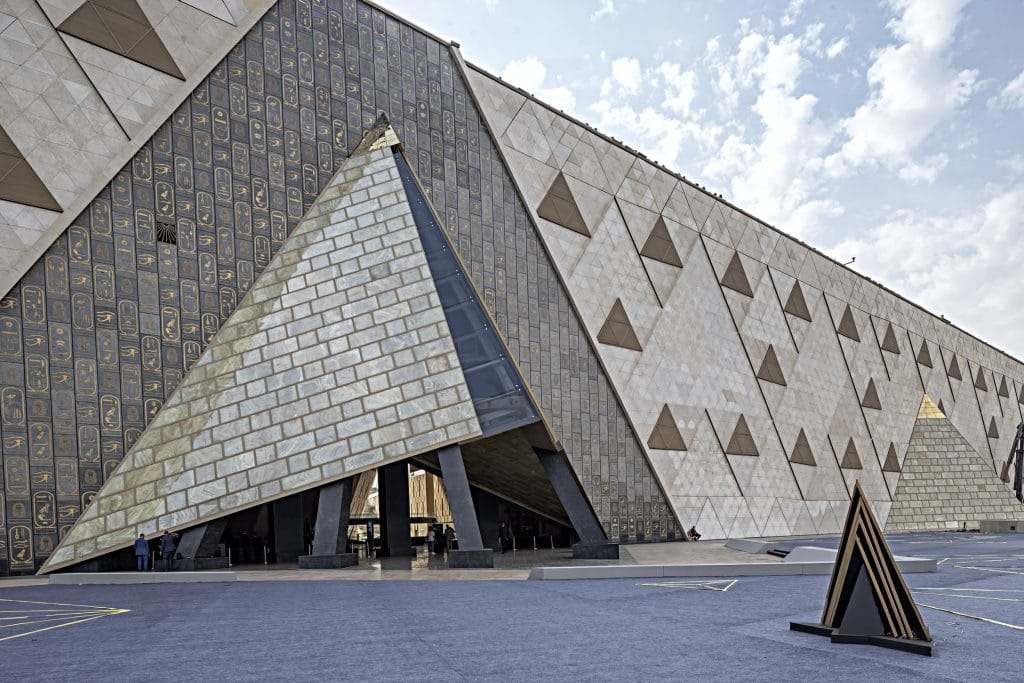
Designed by Heneghan Peng Architects and opened in November, the Grand Egyptian Museum is the largest building on the planet dedicated to one specific field in cultural history.
- – photos: Danica O Kus –

With a visual connection over the desert landscape towards the Giza pyramids, the museum is erected on the Nile plateau on the western edge of Cairo, the capital of Egypt. This specific location was the source of inspiration for the architects, who have used the triangular shape as a motif and a formal link to the ancient monuments, which thus are brought in as part of the spectacular historic narrative of the museum. Besides the visual organising principle, the triangle evokes a sense of uplift, seen as a symbol of spiritual transcendence.

The Dublin-based architects won the design competition in 2003 out of 1500 entries. It was a massive commission for the studio, founded by Róisín Heneghan and Shih-Fu Peng just a couple years earlier. Involving complex engineering, the museum took two decades to be completed, with technical design by Arup and Büro Happold. It is now the grand global centre for Egyptology, housing a collection of rare large scale artefacts as well as conservation and research laboratories.

As a cultural space the museum was envisioned as a contemporary layer extending from the historically charged archeological landscape. The great central stairway of the building is an architectural promenade that takes visitors through six stories, rising gradually towards the top floor and the view towards the pyramids of the Giza plateau. Evoking an ascent in time and space, visitors encounter colossal ancient statues placed along the stairs, culminating on the panoramic view.

Based on a triangular master grid, derived from the alignment between the Great Pyramid of Khufu and the existing urban fabric, a geometric system organises all the museum’s circulation routes with the landscape, façades, and structural modules. The monumental scale is balanced by a refined optical control, precise proportions and with lots of day light pouring in. For the hot climatic conditions a state-of-art thermal system has been a big part of the technical design for safeguarding the preservation of the historic artefacts, while offering views towards the exterior. A play with light continues on the facade clad in semi-translucent alabaster-like panels that glow softly in the desert light.
