
Author: Marianna Wahlsten

Paris Photo, until tragic Friday 13 attacks

Last week 173 galleries from all continents had gathered for Paris Photo inside the great halls of the Grand Palais. 

After Friday’s devastating attacks Paris Photo fair did not open for public anymore, as the city shut down in mourning. Openings elsewhere in Paris coincided with the fair and artists were present. Many of those shows will continue. The Grand Palais retrospective on French photographer Lucien Clergue, who was also the founder of the Arles photo festival, will be open until February next year.

On Thursday I spent the day exploring Paris Photo booths and saw vintage prints of magical mid-19th century landscapes as well as famous 60s and 70s fashion photographs. And then the most recent abstract, camera-less explorations, where the ephemeral subject is just light. Spanning 150 years, the fair is a fascinating overview of the human gaze and the framing of the world: buildings, nature, fashions, people.

Palmyra, Louis Vignes, photography, vintage print, Paris Photo
©Louis Vignes, Syria, albumen print, 1864, James Hyman Gallery

Read more

[mashshare]
Ai weiwei, Caochangdi, Royal Academy

Poetic materiality – Ai Weiwei and intuition

Artist and activist – Ai Weiwei’s collaborations on global architecture projects


At a recent Royal Academy event architect Daniel Rosbottom compared Ai Weiwei’s use of brick in his buildings with the sunflower seeds in the famous Tate Modern installation: “each brick is different, but also part of a multitude”. Ai’s poetic sensibility in the way he uses materials can be evidenced at RA’s retrospective, on until December 13, where a small separate exhibition tells the story of the studio and home he designed in the Beijing suburb of Caochangdi for himself and the series of brick houses around it.

With Swiss architect Simon Hartmann and expert on Chinese art Philip Tinari, Rosbottom spoke about architecture as part of Ai’s art and activism, drawing parallels with minimalism in the way the buildings make you think about spatial volumes. As Rosbottom points out the debt to artists like Donald Judd might be unconscious, but the play with proportion and spatial tension is similar.

Ai Weiwei, HHF Architects, Tsai Residence, Iwan Baan
Tsai Residence, Ai Weiwei and HHF Architects, American Architecture Award 2009, photo ©Iwan Baan

Read more

[mashshare]

Buildings and space, photography at Frieze 2015, London

An afternoon at both Frieze London and Frieze Masters fairs with my friend and colleague, photographer Diego Ferrari was hugely inspiring. Diego teaches at the MA program at Kingston and his work has often been seen on the pages of Grand Tour. He is behind the Tate Britain Urban Encounters symposium, taking place this weekend  and the UrbanPhotoFest with Goldsmith’s College

The built environment is a central subject in fine art photography, especially in the conceptual documentary genre. Bernd and Hilla Becher have been a strong influence for the dead-pan observational style, recognised in the works by the Düsseldorf School photographers. Hilla Becher (1934-2015) sadly passed away October 10, but the legacy created through a 50 years collaboration with her husband lives on – as witnessed also at Frieze London.

Frieze London 2015, Andreas Gursky
©Andreas Gursky, White Cube

The best-known of the Becher School photographers is probably Andreas Gursky, whose pictures are printed on an epic scale and represented by the White Cube gallery in London. At Frieze, Bangkok IX , from 2011, was the same scale (307 x 221 cm) as his previous work, but a more abstract approach: “Here the line between photography and painting gets increasingly blurred – it’s impressionistic” as Diego suggested.

Thomas Struth, Cologne Cathedral
©Thomas Struth, Galerie Rüdiger Schöttle

There was also Thomas Struth’s famous picture of the Cologne Cathedral interior, showing the abstract stained-glass window by Gerhard Richter, exhibited at the Münich gallery Rüdiger Schöttle’s stand. Richter has been another mentor for Struth in the Düsseldorf Art Academy, alongside the Bechers.

Frieze London 2015, JR
©JR, Galerie Perrotin

Equally monumental, we liked JR’s Ballet at the Galerie Perrotin booth. By placing a delicate female figure against the tower block, Diego sensed JR was questioning “ the creative potential against the modernist premise” with the juxtaposition in this large-scale print. Smaller though than the giant ones JR pastes over buildings and urban sites, what the artist/activist has become famous for, but impressive.

Another evocative print – made from a found slide from 1969 – Sea of Galilee was a beautifully recycled view by Israeli artist Sharon Ya’ari, pregnant with political meaning, at the stand of Tel Aviv gallery Sommer Contemporary. Diego was already familiar with Ya’ari’s work and rates him as “one of the great contemporary photographers observing the history of Israel in a serene manner”.

Frieze London 2015, Sharon Ya'ari
©Sharon Ya’ari, Sommer Contemporary Art

Wolfgang Tillmans’ work looks at the private side, exploring incidents of individuality and irrationality. At Maureen Paley’s stand we found an LA cityscape by Tillmans, again a personal, subjective viewpoint, highlighting the urban structure, where the car is such a fundamental element as well as a personal space within the city. At Stevenson gallery Guy Tillim’s dyptych provided a similar viewpoint, freezing a moment from Johannesburg, extended over two panels.

Frieze London 2016, Wolfgang Tillmans
©Wolfgang Tillmans, Maureen Paley
Frieze London 2015, Guy Tillim
©Guy Tillim, Stevenson

At the Focus section, reserved for younger galleries, we discovered a solo show of Amie Siegel’s film and photographic works at Simon Preston’s booth, an interesting formal and conceptual exploration into architecture. Using the modernist icon Villa Savoie and its black copy in Adelaide, Australia as motifs, her work could be read as a reversal of the utopia of modernism, as Diego pointed out. 

Frieze London 2015, Amie Siegel
©Amie Siegel, Simon Preston Gallery

Experimenter gallery from Kolkata, also at Focus, had dedicated their stand to Praneet Soi’s work (main photo), an Amsterdam-based multidisciplinary artist, who explored patterns and forms in South Asian culture. This included a series of photographic collages, looking at the ancient architecture of the Sufi shrines. Soi is a versatile artist who studied painting and now works with a range of media. It’s great seeing contributions from Asian artists, as Diego pointed out, which shows a different perspective into what design and architecture can be.

Frieze Masters 2015, Laszlo Moholy-Nagy
©László Moholy-Nagy, Edwynn Houkk Gallery

Pioneering works from 20th century artists, like László Moholy-Nagy, all shot on film, were on show at Frieze Masters. Moholy-Nagy’s constructivist-style composition Marseille, Rue Canebière, a gelatin silver print from 1929 at Edwynn Houk Gallery, exemplified the revolutionary Bauhaus aesthetic of seeing and composing space. Alongside Ed Ruscha’s Gasoline Station Portfolio series from 1962, for sale at Bruce Silverstein’s booth, these photographs are key works in the canon of 20th century photography.

Moholy-Nagy’s approach is not just about formalism: “In this photograph he gives an interiority to the view that extends to the public space, the pattern acts like veil, emphasizing the separation” Diego pointed out.

Frieze Masters 2015, Ed Ruscha
©Ed Ruscha, Bruce Silverstein Gallery

Ed Ruscha’s rigorous project of documenting the LA vernacular building types could be seen as the forerunner of the Becher school. Ruscha had been admiring petrol stations as a child and had wanted to build miniature models of them. He ended up doing the photographic documentation instead, although in the contemporary context artists are building spatial models in order to then photograph them, as Thomas Demand, one of the Becher disciples, does.

Exploring Frieze Masters you could see how photography has influenced the way we understand and evaluate space – and the continuous circulation of ideas. Moholy-Nagy rejected the idea of space as enclosure, which today is almost a given.

M.W

[mashshare]

360

360_view_1b
Fondation Louis Vuitton rooftop, Paris, designed by Frank Gehry, installation Adrián Villar Rojas                  CLICK IMAGE TO LAUNCH
Royal Academy, London, Ai Weiwei retrospective 2015, installation ’Straight’ in the great hall                               CLICK IMAGE TO LAUNCH
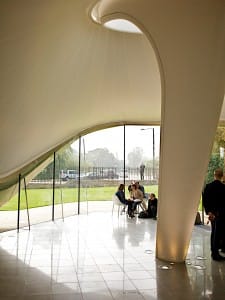
Serpentine Summer Pavilion 2015, Kensington Gardens, London, designed by SelgasCano                                CLICK IMAGE TO LAUNCH
[mashshare]

Lost Palmyra – what was there, by Mark Pimlott

©Mark Pimlott, Palmyra, Baalshamin, 2007

Photographs from Palmyra taken in 2007 by artist and architectural designer Mark Pimlott are part of his wide archive documenting our surroundings and the human impulse. These images show the remains of rare Roman architecture, now destroyed by fanatic iconoclasts. Palmyra is featured in Pilmott’s installation World (2012), situated outside the BBC’s New Broadcasting House. His piece names 750 sites of international significance and encourages viewers to consider the interplay between the seemingly random locations.

©Mark Pimlott, Palmyra, 2007Palmyra 04

©Mark Pimlott, Palmyra, Bel, 2007Palmyra, Bel, Mark Pimlott


©Mark Pimlott, Palmyra, Bel, 2007Palmyra, Bel, Mark Pimlott

Can you describe the atmosphere and what was most special about Palmyra?
To get to Palmyra, you have to drive across the desert. Along the road from Damascus, in the middle of the broad valley of the desert north of the city, a pale landscape, one finds the otherworldly roadside ‘Baghdad Cafe’. We approached Palmyra at the end of the afternoon; an oasis, with the ruins of the ancient city just beyond. The ruins are laid out on the plain, protected by the fortress of hills to the west and its sentinel funerary towers. The cardo and decumanus, remnants of a triumphal arch, as well as traces of walls of houses fill the valley like the desiccated carcass of a great city. Stones and landscape are tan and golden, the sky a flat and wan blue. Standing out from this field of stranded colonnades are the fabulously detailed temples of Bel and Baal-shamin – almost perfect, fabulously detailed. The detail is surprising; crisp and elaborate. In the case of Bel it is monstrous in scale, as is the case of the great Roman ruins at Apamea, Bosra and Baalbek. The scale seems to have been increased in the colonies to be even more impressive.

©Mark Pimlott, Palmyra, Funerary towers, 2007Palmyra, Mark Pimlott

©Mark Pimlott, Palmyra, Funerary towers, 2007Palmyra, Mark Pimlott

Was your trip part of a longer journey?
I was visiting diplomatic friends based in Damascus, in April – May 2007. We saw Bosra, Apamea, the Dead Cities, Palmyra; and in Lebanon, the ruins of Aïn Anjar and Baalbek. Unfortunately, I had to leave the trip early and did not see Krak Chevalier or Aleppo, much to my eternal regret.

©Mark Pimlott, Palmyra, Baalshamin, 2007Palmyra, Mark Pimlott

Could you compare Palmyra and its significance to anywhere else?
Palmyra is as important as any of the very great architectural sites of the ancient world, and it is particularly significant as a site where trade routes and others came together and were welcome. Different gods are all accommodated here. It is a model for what our society used to have the ambitions to be. Therefore it should be considered as a most respected site. ISIS are perfectly aware of what they are destroying, and demonstrating our incapacity to act.

Palmyra, Mark Pimlott©Mark Pimlott, Palmyra, Baalshamin, 2007

Can you imagine any possible strategy to protect from the threat of further damage if the unrest continues?
Actions rather than mealy-mouthed promises might help. ISIS and its agents are determined to destroy civilisation in favour of a realm without time, a tabula rasa that is merely a waiting place for their redemption. To them, everything other is an abomination, apostasy, heresy. This will only stop if civilisation, or ISIS, is annihilated.
M.W
Take a look at World

[mashshare]