Through the latest extension The Museum of Modern Art in New York has added 47,000 square feet of new exhibition spaces. Funded by the late David Rockefeller and four MoMA trustees, the extension cost $450 million. It’s the fourth significant change in the museum’s history, which opened in 1939. The first extension was designed by Philip Johnson in 1964, the second by Cesar Pelli in 1984 and the third by Yoshio Taniguchi in 2004.
The latest by Diller Scofidio + Renfro, in co-operation with Gensler, exemplifies sleek international style, high-tech engineering and minimalistic modernism. A new double-height entrance on 53rd Street has transformed the spatial experience of the museum, adding a sense of openness and transparency. The clear glass façade aims to bring art closer to people. New street level galleries are free for all, with no entrance fee, providing a public space with cultural and educational value. ”Inspired by Alfred Barr’s original vision to be an experimental museum in New York, the real value of this extension is not just more space, but space that allows us to rethink the experience the art in a Museum”, director Glenn D. Lowry pointed out.
The permanent collection has more modernist masterpieces than any other museum. Several of the MoMA trustees are influential collectors, who have donated works. Now the curatorial strategy aims to offer a wider perspective and showcase the complexity of global artistic production. The new spaces allow for juxtaposing different artistic movements and approaches, while also staging numerous works by women, African American artists and galleries specialising in Latin American and Chinese art.
The number of visitors at MoMA each year is over three million. The galleries need to accommodate a huge flow of people and also more room for larger art works. The latest expansion will make circulation around the museum easier, while also providing a wider view of one of the greatest collections of sculpture, painting, architecture, design, photography, media, performance and film together. The new presentations will illustrate links and connections between different types of artistic production. Housed over six floors, where some of the galleries will be medium-specific, the museum aims to broaden the ways in which art can be displayed, understood and discussed. The architectural concept encourages several alternative routes through the collections.
‘The Poetics of Reason’, Lisbon Architecture Triennale 2019
Showcased inside some of the city’s charming buildings, five main exhibitions of Lisbon Architecture Triennale respond to an evocative theme – The Poetics of Reason. Set by chief- curator, the French architect Éric Lapierre (1966), the theme translates key values from modernity, moving away from the phenomenologically-inflected theories towards a more rationalist approach. However, it’s not about mere functionalism, but could be seen as a discursive turn, where ‘poetics of space’ is replaced by an alternative focus.
Chief Curator Éric Lapierre introducing the main exhibition at MAAT Museum
Lapierre is an award-winning architect in France, running his own studio since 1999 and has been teaching at universities in Marne-la-Vallée (France), Lausanne (Switzerland) and Harvard (US). “To curate a show is not to show my own work, but it’s of course completely coherent with what I do. I teach ‘rationality’, I practice it and I curate it”, Lapierre says. For the Triennale he has gathered a curatorial team from colleagues working on his teaching program. Lapierre is not the typical, intensely analytic and manic architect, but a more laid-back theorist, inspired by rock music (check out their Instagram @eye_experience), and Velvet Underground in particular. In visual arts the surrealists are his source of inspiration, evident in the selection of models displayed in the main show, including works by Belgian architects Kersten Geers, David van Severen and De Vylder Vinck Taillieu Architects.
As the president of the Triennale José Mateus points out, the exhibitions and events touch on a global topic, instead of national concerns. The main exhibition The Economy of Means, curated by Lapierre and presented at the MAAT Museum, investigates a broad subject matter, where the fundamental question about economy can leave you slightly puzzled. While bringing out a range of references, both historic and contemporary, the narrative folds out as a dense overview into the history of architectural structures, its meaning, use and development. Although the main argument might seem slightly obscure – raising some criticism – visitors will acquire huge amounts of knowledge. The galleries are packed: video interviews, slide shows, architecture models and lots of drawings – perhaps too many drawings… In order to make the most of it, you would need to allow plenty of time.
The main exhibition is based on classical French theory, starting with a quote by Philibert de l’Orme from 1567. The pursuit of structural continuity develops from de l’Orme’s thesis and the meaning of time (past, present and future), that needs to be considered for each architectural project. The structural theory developed three centuries later by Viollet-le-Duc could be seen as underpinning Lapierre’s proposition. However, this key reference gets slightly lost amid the vast amount of conceptual links. Overall the galleries provide an experience, where ideas run deep with meaning. “For me, when I think of poetical reason, it’s an attempt to define the specificity of the rationality, it’s not completely cartesian”, Lapierre says, “So it’s important to understand, that we don’t have on one hand the boring rationality and then the fancy artist, it’s completely intertwined and included to each other.”
Elsewhere in town an atmospheric 18th-century palace, the Sinel de Cordes, is home to exhibition titled Natural Beauty. It’s curated by young architects Laurent Esmilaire and Tristan Chadney, expanding Lapierre’s proposition. Here the wider theme of rationality is explored in relation to natural forms. Showcasing classic examples including Gaudi’s investigation on parabolic vaults and Buckminster Fuller’s geodesic dome, the curators are showing a genealogy of formal logic translated into contemporary practice. While talking about the arch Esmilaire refers to the Rolex Centre in Lausanne by Sanaa, which shows a development of the vaulted ceiling: “Continuity is something that always exists”, he says, “Rationality is very important in classical French architecture, it’s in our DNA. But we don’t want to say its a French matter, we want to highlight its spread everywhere”.
At the National Museum of Contemporary Art (the most central location), Inner Space is an exploration into imaginary states underpinning creativity in architecture. The curators of this exhibition, architects Mariabruna Fabrizi and Fosco Lucarelli also publish socks-studio.com and run microcities.net. The idea of evoking the scope of unconscious operations behind each project is a beautiful starting point. By showcasing a wide range of artistic devices that are part of the creative process and the abstract operations, this show builds a historic view, culminating in a virtual presentation of imaginary space. Well researched and mind broadening, but hard to pin down. At the Culturgest contemporary arts centre, the exhibition What Is Ornament tackles a more precise theme within the history of architecture. This exhibition curated by architects Ambra Fabi and Giovanni Piovene focuses on the meaning of ornament after its significance has been contested by theorists such as Adolf Loos. Today, as Fabi pointed out, the entire façade of a building can be considered an ornament.
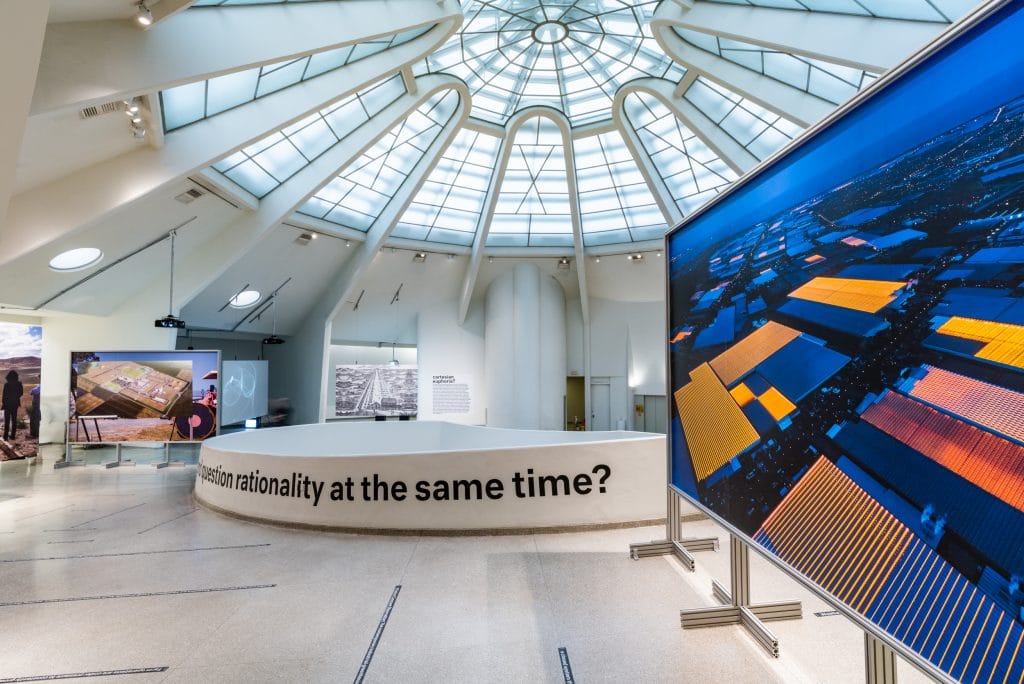
At the basement galleries of CCB, (now run by André Tavares, chief curator of the previous Triennale), the exhibition on agriculture shows how the history of anthropocene is also the history of rationalism. The concept is drawn from a research project that curator, philosopher Sébastien Marot conducted in parallel with work for OMA and another exhibition by Rem Koolhaas (opening at Guggenheim, New York in 2020). Displayed through a series of large boards, the exhibition is like a book showcased on the walls of a museum. It’s a slightly tedious way for gathering information, but some video interviews provide a change of pace while examining the long lines of hung data and illustrations. As an argument that aims to introduce alternative models for agriculture, Marot proposes forms for an urbanism of the future. He didn’t get convinced about presenting Koolhaas’ more futuristically themed proposal about agriculture and GMO, which was probably the point where their paths separated.
Lapierre’s curatorial proposal explores a formal development in architecture, underpinned by changes in human consciousness, and the influence of surrealism and minimalism. The need to go beyond mere functionalism, while retaining a certain logic, is the inspiration that can be retained from the exhibitions. The rich historic narrative is based on exhaustive research, although key ideas do sometimes get lost in the amount of information. Exemplified by drawings, models, photographs, interviews, slideshows and illustrations, the curatorial perspective is one of an architect immersed in multiple links of significance. As exhibitions, however, the triennale proposes an outlook and overview, where classical French theory of structural logic is clearly redefined.
The theme ‘Beauty Matters’ was set by chief curator Yael Reisner to remind us of architecture as an aesthetic experience. As architecture often seems to be focused on moral and political aspects of design, Reisner aims to bring attention back to the concept of beauty. The Biennale offers an energising program of talks and events and an inspiring exhibition showcased at the Museum of Estonian Architecture.
Winner of the pavilion competition, ‘Steampunk’ installed in front Museum of Estonian Architecture
The exhibition inside the museum consists of installations by international architects including Sou Fujimoto, SOMA, Kadri Kerge and Barnaby Gunning. One of the highlights is the experimental timber construction, installed in front of the museum. The wooden installation ‘Steampunk’ is the winner of a competition to create a pavilion using wood as material. It was conceived by a team, where designers and architects experimented with computational design in order to explore new technological possibilities. The brief for the competition was to design a ‘primitive hut’, an idea derived from the historical discourse of architecture, but interpreted for today. The competition allows young architects to experiment and research around material possibilities and techniques. A selection of shortlisted entries is exhibited within the museum. The ways in which they demonstrate ‘beauty’ is an interesting matter and shows how notions of beauty are wide and varied. The team behind the winning design explain: “The beauty of the project lies in this tension: when to give and take, when to adhere to preconceived design intent and when to abandon precision and begin to react” – hence it’s all about the process.
Steampunk installation, Tallinn Architecture Biennale 2019, from above
The pavilion is created with steam-bent wooden boards of 100 x 10 mm, bound together into a sculptural form, that can be entered and explored from various view points. It is a kind of futuristic vision of the modernist bent-ply aesthetic, created with a digital system, in which no physical drawings were made. It plays with surface and volume in the form of a sculptural giant timber knot. The winning design is a collaboration with a team of young designers and architects based in London, and Fologram, a design research practice and technology startup. Fologram is a Melbourne-based company, which builds software for artistic and architectural projects. For the experimental installation holographic models were used in the construction process.
Made of steam bent wood, with digital technology
The team behind Steampunk: Gwyllim Jahn, Cameron Nenham, Someen Hahm, Igor Pantic
The winning team used robotics and a very high-tech approach, while working with a natural material. The result shows how technological interventions interact with material reality. It’s a deliberate gesture showcasing robotic production and automation, while experimenting with precision and intentionality. From a neo-kantian viewpoint, beauty is definitely a relative matter, and here extended beyond the product itself into the process of production.
Arles in the South of France is defined today by a strong relation to photography. This year is the 50th anniversary of the start of the Rencontres d’Arles festival, where all forms of photography are celebrated. The city has changed as has the forms in which photography finds its ways of expression.
Exhibition ‘Modernity of Passions’, curated by students of ENSP at new building by architect Marc Barani
The festival was founded by photographers and curators Lucien Clergue, Michel Tournier and Jean-Maurice Roquette in their hometown. In half a century it has grown into a vast summer long ritual for all photography enthusiasts. As the festival director Sam Stourdzé points out, the city’s identity with historic landmarks, has been transformed by a contemporary art form, photography.
This year the start of the festival coincided with the opening of a new building for the École Nationale Supérieure de la Photographie, designed by Marc Barani. The photography school will mark a new era in Arles. Built close to the Luma Arles arts foundation, the city will continue expanding outside the historic centre.
The new photography school at Arles, designed by architect Marc Barani
Maja Hoffman, the founder of Luma Foundation, has a mission to activate the city and local culture with arts and contemporary architecture. She started working for the photography festival as Lucien Clergue’s assistant, when still a student. Since 2014 Luma Arles has been hosting exhibitions at the Parc des Ateliers, where old industrial halls have been transformed into 12000 square metres of gallery space. It’s now the largest exhibition area during the festival.
There are over fifty exhibitions in total of different sizes, spread around Arles, also as satellite events in surrounding cities and historic sites. Beautiful historic monuments, such as Abbaye de Montmajour outside Arles, have been converted to galleries during the festival. In a city with such a strong heritage of Roman and Romanesque architecture, the history adds another layer to the experience.
Environment and domestic spaces are key themes this year at the Rencontres. Some humanistic views into the history of architecture, concern for the planet as well as the changing standards of living, are pressing topics amongst the many issues explored.
At Abbaye de Montmajour a series documenting the works by French architect Fernand Pouillon in Algeria is beautifully showcased. A joint project by Daphné Bengoa and Leo Fabrizio aims to show the human aspect in Pouillon’s architecture. Pouillon is a controversial figure and has designed some important post-war constructions. Bengoa says she developed a deep understanding of the complex questions and the humanity in Pouillon’s oeuvre during this project.
Église de Frères Pêcheurs, hosting ‘Dataspace’
Exhibition titled Dataspace in central Arles is housed at Église des Frères Prêcheurs. French photographer Philippe Chancel’s work is an outcome of fifteen years of documenting the decline of our planet. Through an interest in ecology and environmental questions, Chancel’s classic documentary style photos describe a world in crisis and the complex issues of globalisation. Showcased in the historic space, the display gains an extra layer of meaning.
Danish artist Jakob Kudsdk Steensen, VR Festival
The VR presentations provide a channel for immersive experiences, where photographic images are used as a starting point for complex visual explorations. Danish artist Jakob Kudsk Steensen’s work Re-Animate, created in collaboration with sound artists, animators and scientists, was awarded a special mention from the jury.”Through VR I can offer a viewpoint unlike any other media, going very close to nature and showing it on another scale”, Steensen said.
An architect of international repute at a young age, Junya Ishigami is known for alternative models and expressions. Complimented by a digital app launched this week, an artistic summer experience is there to be discovered in London’s Kensington Gardens – and free for all.
photos by Danica Kus –
A sloping roof of dark grey Cumbrian slate will occupy the front yard of the Serpentine Gallery in Kensington Gardens this summer. It’s the latest commission in the architectural programme of the Serpentine Gallery, led by artistic director Hans Ulrich Obrist. The architect in charge this year is the 45-year old Japanese Junya Ishigami, whom Obrist first met in the 2010 Venice Architecture Biennale.
Ishigami was awarded the Golden Lion that year at only 34 years old. At the biennale Obrist had been struck by Ishigami’s poetic approach and explains how he has always seen great architecture as an outcome of a constant dialogue with other art forms. In Ishihgami’s project for the Serpentine a multi-layered philosophical and artistic dialogue is there to be discovered, in which the built form draws from the natural environment.
This summer the Serpentine programme will offer a digital element exploring the landscape, the vast green space surrounding the Serpentine Gallery. The Deep Listener app was created by Danish artist Jakob Kudsk Steensen and can be downloaded on a smartphone. The artist is interested in ecological questions and has brought a new dimension to the park experience. His work was awarded at the Rencontres d’Arles photography festival last week, showing great creative vision and skills developed through animation and video games. brought to a new context in a collaboration with Google Arts and Culture.
The pavilion building has been conceived as an imaginative play with materiality and weight, representing the most basic architectural element: the roof. The unusual structure is the outcome of formal experimentation, created with the help and technical expertise by AECOM this year. It is a collaboration with traditional stonemasonry as well as high tech digital design. The heavy stone roof supported by thin steel columns could be seen as an interpretation of traditional architectural conventions. It reminds Abbé Laugier’s ‘primitive hut’, a conceptual idea in architectural history translated here into contemporary context.
Below the slated roof, an open space connects with the surrounding landscape by its free-flowing abstract form. Slightly ominous, its formal play could be seen as reflecting the global political and ecological situation. Like a shelter below a bird’s wing, the space is designed to be a comfortable environment within the garden, as Ishigami explains. His architectural oeuvre has been influenced by Le Corbusier, which can be recognized on the carefully considered details and proportions. Perhaps an homage to the corbusien legacy could be read in the symbolic of the raven’s wing.
For Ishigami the six months time frame given from start to completion was a challenge. He proposed several projects to the Serpentine team and then discussed the possibilities. Normally for each architectural project he starts by a longer period of research, because each project is disconnected from any previous work, as Ishigami explains: ”Each project and each site is unique”. This is an approach he adopted from working for the japanese firm SANAA at the start of his career. One of the challenges at the Serpentine pavilion is its temporary nature. The pavilion will have another life beyond the Serpentine site. It will be reconstructed elsewhere, which in terms of suitable materials poses considerations in order to be easily rebuilt and sustainable, Ishigami explains.
Guardian’s architecture critic Oliver Wainwright claimed that UK safety regulations had not been in favour of the project and suggested that architects should be given more time than six months to finish the pavilion design. This would completely transform the initial idea though. Also as a yearly summer event, it is one of London’s summer rituals. It should be accepted that there is an element of urgency and transience as a starting point.
Ishigami himself points out that he was aware of the UK regulations from the start and is used to the varying requirements in different global situations through many other international projects. He explained that normally there would have been more time to find aesthetic solutions. But in the final pavilion design the only details that he finds slightly distracting are the small dots on the transparent walls.
This year’s pavilion is the nineteenth completed commission and forms a chapter in some incredible experimental approaches in architecture. Each pavilion seems to continue within a formal, shared narrative with the previous ones, introducing contemporary architecture to wider audiences – a unique architectural experience and free to visit throughout the summer. In 2016 with Bjarke Ingels and five smaller pavilions, it was the most visited architectural exhibition in the world.
For Obrist a key idea in the Serpentine Pavilion is the legacy of Zaha Hadid that ’there should be no end to experimentation’. Hadid, whose pavilion was the first, is the spiritual mentor of this architectural programme. Since then each pavilion has represented an experiment, a temporary building in a unique site in one of the most iconic locations in the world. The only one that never got realised – perhaps for being too radical for this historic location – was in 2004 by MVRDV.
Like each summer the pavilion will host Park Nights, a programme sponsored by COS for artists, fashion designers, architects and film makers on selected Friday evenings. The Serpentine Pavilion is a much anticipated event each year, completed always with incredible attention to detail. This year Ishigami’s design will provide an unforgettable meeting place for all London visitors.
The new museum in Doha is a building of the digital age: sculptural play enhanced by the art of engineering. In the form of giant disks of different sizes and directions, the museum surrounds the restored historic Palace of Sheikh Abdullah bin Jassim. The galleries around the palace create a circular promenade of 1,5 km in total. Showcasing the cultural, economic and environmental developments in Qatar through spectacular films and installations, including a 360-degree video installation by artist Doug Aitken, the galleries span over 7000 square meters for permanent collections and 1700 for temporary exhibitions.
A park with native plants designed by French landscape architect Michel Desvignes provides space for large sculptures, including works by Liam Gillick, Louise Bourgeois and Martin Creed. ALFA, the spectacular waterside installation, shaped to reflect the geometrics of Arabic calligraphy, was commissioned from French artist Jean-Michel Othoniel. With free entry to locals, the museum is a vast public space shaded and protected from the heat of the desert climate. A temporary exhibition Making Doha 1950-2013 (28.3 – 30.8.2019) curated by Rem Koolhaas and OMA/AMO explores the ongoing development of Doha and the global discipline of architecture.
As urban gestures, Jean Nouvel’s buildings are strong artistic statements, conceived as visually striking spatial experiments. Nouvel says his approach has been inspired by his mentor French architect Claude Parent, for whom he worked in the beginning of his career. His design for L’Institut du Monde Arabe in Paris (completed in 1987) exemplified great visual impact, where sophisticated technology controlled the mechanics of interlaced window screens, symbolising a connection between mathematics and nature. In Doha the symbol for formal inspiration is the ‘desert rose’, a natural mineral formation in the Gulf region. This starting point is seen by Nouvel as the most primitive form of architecture.
In the Arabic world architectural symbolism and innovation has been famously incorporated into the changing urban fabric, resulting in spectacular forms, where architecture plays a central role as cultural expression. Architecture can be understood as a language of time and space, form and place, where history and the surrounding landscape provide the context. From a functional perspective, what Nouvel has created seems like a giant massing of brise-soleil. Next to the desert, facing the 900- meters-long lagoon, the form creates continuity in space and time.
The new museum follows a succession of institutional buildings by international architects, such as Rem Koolhaas and I.M Pei, transforming Doha’s urban identity. With seemingly endless financial resources, contrasted though by reports of problems in working conditions, these public buildings provide opportunities for architectural experimentation as well as grand civic spaces for the Qatari residents and visitors alike.
The extreme desert climate is a point of departure for bold formal innovation. Jean Nouvel’s architectural concept interacts with the social and climatic situation that prevails in Qatar and conditions this kind of architectural culture. In contrast to the towers marking the skyline, Nouvel has created a form lying low by the Doha Bay. As formal play, it responds to the site, and could not exist anywhere else. Unique and extravagant – it’s an expression of strong cultural ambition.